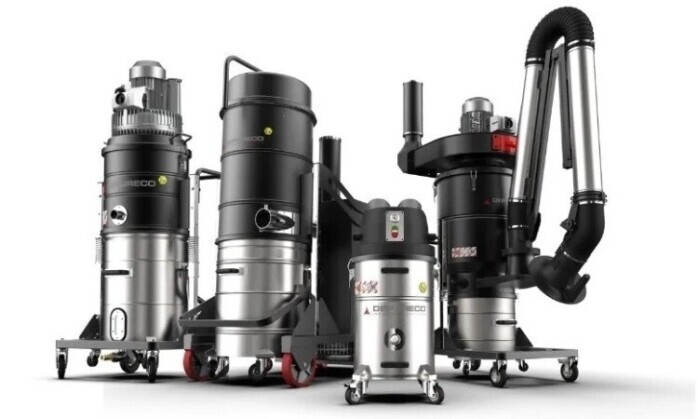
We work with multiple vendors so we aren't tied to one product line. We don't have to make your application fit the equipment we manufacture. We can find equipment that fits your application.
Do I need an Industrial Vacuum or Dust Collector?
Step 1: Understanding the Dust and the Process
Before recommending equipment, Controlled Air Design asks customers to complete an application questionnaire.
Click HERE for the Central Vac Questionnaire Form
1) What is the dust?
2) What are the KST & PMax values of the dust?
3) What is the bulk density per cubic foot for the dust?
4) How many operators at one time will be vacuuming worst case?(1,2,3,4,more?
5) How much volume will be vacuumed per cleanup?(1, 5,10,25gallons,more?
6) How long of a hose would you like for each operator? (10,15,25?)
7) From where the main vacuum will sit outside to the furthest pickup point how far is it? (25,50,100' more?)
8) How many floors or levels will the pipe run?
9) Will you be vacuuming any liquids?
10) Do you want BIBO? (bag in bag out)
11) Do you need HEPA?
12) What do you want the vacuumed material to go into? drum, hopper? bulk bag? other?
Email your answers to: sales@controlledairdesign.com
We want to know what material is being collected, how the dust is generated, how much is produced, the physical characteristics of the dust, the required collection points, and other information that can affect system design.
For combustible dust applications, we also ask for available dust test data and whether the equipment will be installed in an ordinary location (ORDLOC) or a classified hazardous location (HAZLOC).
These answers help us determine what type of collection technology should be considered before selecting a manufacturer or model.
A lot of people are initially focused on finding a piece of equipment labeled for combustible dust. But selecting the correct system requires more than finding an “explosion-proof” vacuum or dust collector. Controlled Air Design begins by evaluating the application itself.
Step 2: Determining the Required Airflow
In this application, aluminum dust needed to be captured and conveyed through the collection system.
Airflow requirements can be evaluated using the basic relationship:
Q = V × A
Where:
Q = airflow in CFM
V = air velocity in FPM
A = duct cross-sectional area in square feet
Using a 6-inch diameter duct, the cross-sectional area is approximately 0.196 square feet.
At a design conveying velocity of 4,500 FPM:
4,500 FPM × 0.196 ft² = approximately 883 CFM
This calculation immediately becomes an important part of equipment selection.
A machine may generate substantial vacuum pressure, but that does not necessarily mean it can move enough air through a 6-inch duct to satisfy the airflow requirements of a source-capture dust collection application.
Step 3: Understanding the Difference Between a Vacuum and a Dust Collector
Industrial vacuums and dust collectors are both valuable pieces of equipment, but they are designed to accomplish different tasks.
An industrial vacuum typically uses a relatively small-diameter hose and produces high static pressure at comparatively low airflow. This makes it well suited for housekeeping, direct tool connections and applications requiring material to be moved through smaller hoses.
A dust collector uses a different fan design to move significantly larger volumes of air.
When the objective is capturing airborne particulate at the source, sufficient airflow must be established at the hood or extraction point and maintained through the ductwork.
Adding a large extraction arm to a high-vacuum machine does not automatically make it a high-volume dust collector. The fan must be capable of producing the required combination of CFM and static pressure for the complete system.
Step 4: Evaluating the Application Using NFPA 660
For combustible dust applications, Controlled Air Design uses NFPA 660 and the characteristics of the material as important guides during the equipment-selection process.
The type of dust matters.
Aluminum, titanium, magnesium, wood, plastic, carbon and other combustible materials can present very different collection requirements. Bulk density, particle characteristics, dust explosibility data and the process generating the dust can all influence the appropriate collection approach.
The solution may involve a dry collector, wet collector, industrial vacuum or another specialized collection technology.
This is why we don't begin an application by choosing a piece of equipment.
We begin by understanding the process.
Step 5: HAZLOC or ORDLOC?
Is the equipment being installed in a classified hazardous location, or is it being installed in an ordinary location while handling combustible dust?
Those are not necessarily the same situation.
Controlled Air Design asks customers to identify whether the proposed equipment location is HAZLOC or ORDLOC so that equipment with the appropriate electrical and construction characteristics can be considered.
This prevents the term “explosion proof” from becoming a substitute for properly evaluating the application.
Step 6: Selecting the Technology Before Selecting the Manufacturer
Once the material, process, airflow requirements, system resistance and installation environment are understood, we can determine the appropriate type of collection system.
Only then do we begin selecting equipment. Controlled Air Design is 100% independent and works with approximately 20 manufacturers specializing in different areas of industrial air cleaning.
Some manufacture exceptional industrial vacuums. Others specialize in high-volume dust collection, wet collection, downdraft systems, mist collection, smoke and fume extraction, hazardous-location equipment or other specialized technologies. That allows us to approach an application differently.
Start With the Application, Not the Equipment
If you're unsure whether your process requires an industrial vacuum, portable dust collector, wet collector, downdraft system or another type of source-capture equipment, start by telling us about the application.
Controlled Air Design will review your process requirements and work with our network of specialized manufacturers to help identify an appropriate solution.